

What Size Gasline For John Deere Trailfire
The John Deere snowmobile feel lasted nearly a decade. The early on 1970s saw John Deere enter the snowmobile market with sleds that channeled Bombardier's best-selling Ski-Doo Olympiques of the period. Information technology was not casual, just John Deere didn't have an exclusive engine supplier or an eager-to-ain fan base of snowmobilers and Ski-Doo was king of the snows. John Deere was king of the farmlands. And wanted a sled to capture buyers' attending.
By the mid-1980s when John Deere decided that lawn tractor production rather than snowmobile production provided more sensible profitability for its Wisconsin-based Horicon Works manufactory, the agricultural products giant had planned to innovate a strut type front break for its fourth generation of sleds. While Deere's initial "400" and other early models could be called copycats of Ski-Doo, future models showed innovation. Well, that 2nd generation, often referred to as "span busters," didn't innovate in the weight department. It had been Deere'south goal to strengthen its sleds, but the company went overboard and made them heavy, bulky and poor handling.
Learning from their errors and sensitive to a new world (for Deere & Company) of criticism, Deere engineers totally revamped the product line and brought light and nimble handling models to the snows. Amidst the first entrants was the Trailfire.
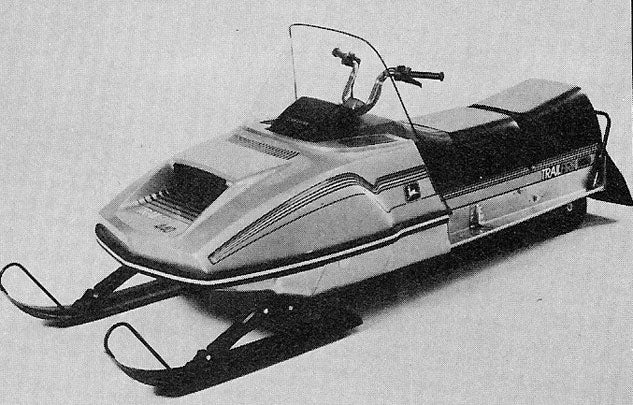 The 2-up Trailfire accomplished thirty-plus miles per gallon in a magazine-sponsored fuel economy run over a twenty-mile form.
Where heavy-duty meant heavy fe in the world of tractors and combines, the world of snowmobiling meant light-footed for over snow performance. That second generation of sleds didn't go over snowfall so much as information technology plowed through information technology. The Trailfire proved a polar opposite. And although Deere didn't have an exclusive engine supplier, it did accept an arrangement with Kawasaki, which used nearly identical engines in its own Kawasaki-branded sleds. Those engines worked through finely-tuned clutch setups that included a Comet drive with parameters identified by Deere engineers to provide aplenty on trail "get" and above boilerplate fuel efficiency.
COMPETITION: Read our review of the 1975 Polaris TC
In the Trailfire era, gasoline supplies were spotty and prices tended to elevate without much warning. Audio familiar? That was one reason Deere engineers worked to provide expert fuel economic system for its Trailfire serial. To bear witness their acumen, the Trailfires tended to do very well in fuel economic system runs of the time. In fact in a snowmobile-sponsored fuel economy trial, a 1982 John Deere Trailfire Lx with a 440cc fan-cooled twin managed 33.4 miles per gallon, which was meliorate than the 25.1 mpg a 1980 Trailfire 340 accomplished.
As the magazine editor and official overseer of the fuel economy runs at that fourth dimension, I suggest you be cautioned that the trials were run over a very deliberately called 20-mile course that consisted of long open up runs and very few route crossings. And consider that speeds averaged between 20 and 25 miles per 60 minutes. Then, also, the sleds were ridden and maintained by factory personnel. The chances of a real-earth rider getting such mileage numbers were, at best, unlikely. But, then, these fuel economy runs proved as consistent as the coast-to-coast Mobil Economy Runs of the 1950s and 1960s. The results of the runs were verified and the sleds did go the mileage claimed. It'south unlikely any snowmobile enthusiast would ever drive twenty miles at such boring speeds. Well, at to the lowest degree none that we know!
We besides conducted high speed and handling runs back in that day and fourth dimension, too. The new brood of lightweight John Deere trail sleds was truly nimble and could turn on a 9/sixteen-inch washer.
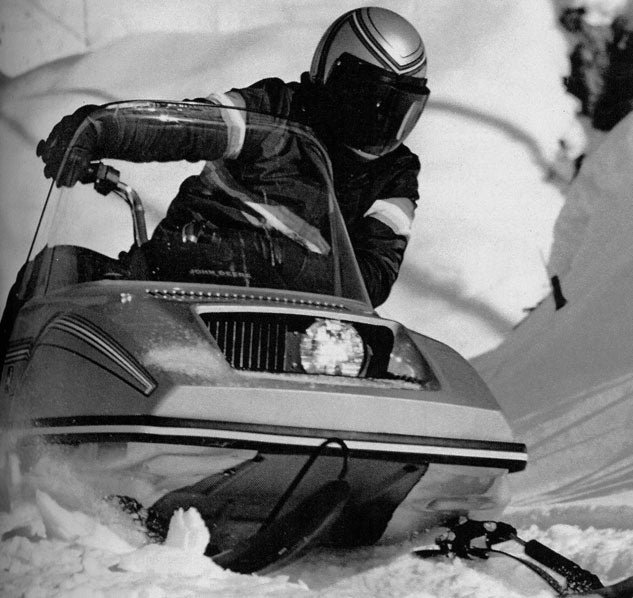 Handling came from the Trailfire's extremely low eye of gravity and lightweight graphic symbol.
While Kawasaki provided the base power for the Trailfire, Deere engineers established their own specifications. For case, the Trailfire'south fan-cooled 436cc Kawasaki twin used a single 34mm slide valve carburetor. The Kawasaki Intruder 440 featured a like two-stroke powerplant, but Kawasaki engineers went with dual 32mm Mikuni slide valve carbs. The clutching packages differed as well. Deere chose a Comet drive set to its specs and a driven of its ain making. The Kawasaki used its own design. And then there would be no confusion, John Deere's Kawasaki-sourced engines were renamed as Deere Fireburst powerplants. So, you see, this whole sharing affair predates the Chill True cat/Yamaha hook-upward by decades!
COMPETITION: Read our review of the 1986 Yamaha Inviter
To the Deere engineers' credit, the Trailfire concept provided an excellent backbone for futurity college performance models. While non exactly the same structure, the Trailfire concept served equally the underpinning for Deere'south liquid-cooled Liquifire series, which featured a Kawasaki liquid-cooled 436cc twin. The Sportfire was a fan-cooled version of the Liquifire and designed every bit a solo saddle sport sled, leaving the Trailfire in the family fashion.
These John Deere sleds had to compete with the Polaris TX-L Indys and Centurion 500. The Trailfire sold against Chill Cat's popular Panther and Ski-Doo's Everest.
When introduced, the new breed of Deeres enjoyed the benefits of oil injection and CD ignition. These things don't seem like big deals today, but in the belatedly 1970s and early 1980s it set sleds autonomously. Weight wise the Trailfire LX claimed a dry weight of 388 pounds! Today's lightweight sleds make news when they clear the 400-pound hurdle.
We tin't pretend that we weren't biased in favor of the Deere snowmobiles. For enthusiasts and snowmo-writers akin, Deere & Company snowmobile executives were offset form. Why not? The company had a sterling heritage and snowmobiles sold into its corporate landscape of agrarian roots. Still, when the time came to brand a corporate decision to driblet the snowmobile line, the decision proved far easier than those of us in the sled biz thought. One day Horicon Works stamps out sled chassis and the next solar day lawn tractor platforms roll off the line. Life went on, one Deere product at a time. But in the interim, John Deere proved that it could brand a world-class snowmobile that could handle every bit well as any competitor and go the best fuel mileage of any full-size two-up sled. When the end came, there were Deere prototypes with strut forepart suspensions and the appearance in 1982 of a new series of direct drive sleds in the Snowfire and Sprintfires.
COMPETITION: Read our review of the 1974 Kawasaki SnoJet
John Deere managed quite a turnaround in its decade of producing snowmobiles. The early on 1970s models borrowed from the Ski-Doo designs and the final Trailfires evoked an internal engineering path that brought the best of snowmobiling to its product line. As information technology turns out, the John Deere partnership with Kawasaki would endure with Kawasaki power fitted to some Deere lawn and garden products. And, Deere has proven that it didn't totally abandon the powersports world equally it now produces a summit notch side-past-side all terrain vehicle in its RSX 850i. These vehicles keep a legacy built on snowmobiles.
| 1981 John Deere Trailfire Specs | |
| Engine | Fireburst (Kawasaki-sourced) 436cc & 340cc fan-cooled twin; single 32mm carb |
| Horsepower | NA |
| Bulldoze | John Deere/Comet bulldoze with Deere driven |
| Front Interruption | Tube shock-assisted leaf leap |
| Rear Suspension | John Deere parallel runway slide |
| Length | 102.0 in. |
| Width | 37.0 in. |
| Height | twoscore.0 in. |
| Ski Opinion | 37.0 in. |
| Rails | 15.75 x 116 Rubber with riveted cross bars |
| Weight | 381 lbs (claimed) |
| Brake | Mechanical disc |
| Fuel Chapters | seven.76 US Gal |
| Features | CD ignition, oil injection |
| Price | In 1981 – US$two,549 ($half-dozen,339.55 in today's dollars) |

What Size Gasline For John Deere Trailfire,
Source: https://www.snowmobile.com/manufacturers/others/john-deere-trailfire-vintage-review-1715.html
Posted by: worthymands2002.blogspot.com
0 Response to "What Size Gasline For John Deere Trailfire"
Post a Comment